Alone Together: The New Architecture of Solitude and Community at America's Finest Resorts

There is a particular kind of loneliness that can settle over a traveler in the wrong resort. It arrives not in the absence of people, but in their presence — in the hollow exchange at a crowded breakfast buffet, in the anonymous corridor of identical doors, in the sensation of being surrounded by hundreds of strangers who share nothing but a check-in date. Conversely, there is an opposite failure: the resort so zealously private, so obsessively compartmentalized, that guests vanish into their villas and emerge only to depart, having experienced something closer to solitary confinement than genuine escape.
America's most discerning travelers have grown fluent in recognizing both failures. What they seek instead is something far more nuanced — what hospitality designers and social theorists are beginning to call calibrated proximity: the sensation of being held within a community without being consumed by it.
The Architecture of Selective Visibility
The physical language of this philosophy begins long before a guest enters a room. At the most thoughtfully designed premium resorts, the approach sequence itself communicates intention. Pathways meander rather than march. Sight lines are carefully managed so that guests glimpse one another — a couple reading on a terrace, a solitary figure walking toward the water — without ever feeling observed or obligated.
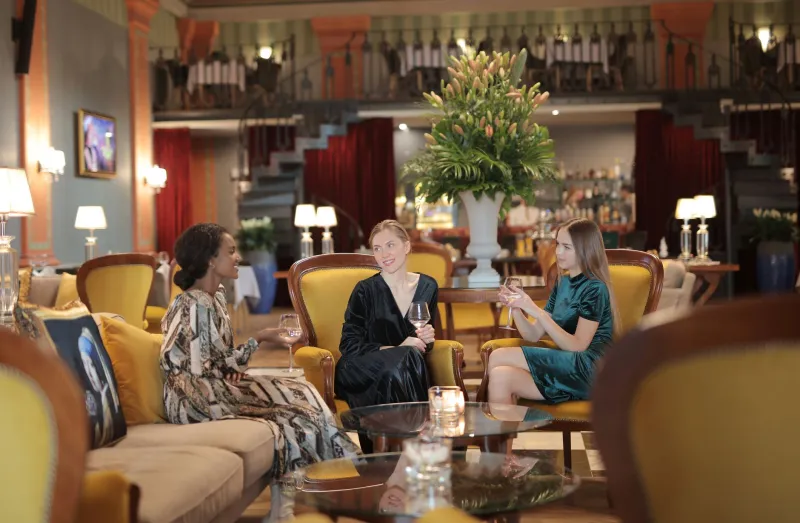
This is deliberate. Landscape architects working with leading hospitality brands speak of designing what they call "social thresholds": transitional spaces that allow guests to modulate their own degree of engagement. A partially screened terrace that faces a shared garden. A reading alcove positioned at the edge of a lively lounge, close enough to absorb the ambient warmth of conversation without requiring participation. A pool with a quiet end and a social end, separated by nothing more formal than a change in the arrangement of lounge chairs.
The message embedded in these spatial decisions is one of invitation rather than obligation. You may join. You need not.
Technology as an Invisible Mediator
Beyond the physical, technology has become a quietly powerful instrument in managing the tension between privacy and connection. The most sophisticated resort platforms now allow guests to signal — entirely on their own terms — when they are open to interaction and when they prefer undisturbed solitude.
Some properties have introduced opt-in social discovery features within their digital concierge systems, allowing guests with shared interests to be gently introduced by staff rather than left to the awkward machinery of chance. A guest who has indicated a passion for fly-fishing might find, without any intrusion, that the concierge has arranged a morning expedition with a fellow enthusiast staying at the property. The encounter feels serendipitous. It is anything but.
This kind of orchestrated spontaneity — technology performing its work invisibly, leaving only the warmth of human connection visible — represents one of the more elegant achievements in contemporary hospitality.
The Role of Staff as Social Architects
No algorithm, however refined, replaces the judgment of an exceptional hospitality professional. At the finest American resorts, staff training has evolved well beyond the mechanics of service to encompass something closer to social intelligence. A skilled concierge reads the room — and the guest — with the same attentiveness a gifted host brings to a private dinner party.
This means recognizing when a guest lingers at the bar hoping for conversation and when the same guest's body language communicates an unambiguous desire for quiet. It means knowing which guests might benefit from a shared excursion and which would find such an arrangement an unwelcome intrusion. The calibration is constant, subtle, and deeply personal.
The resorts that do this well understand that their staff are not merely service providers. They are, in the most meaningful sense, the connective tissue of the community — the element that transforms a collection of private rooms into a living, breathing social organism.
Designing for the Introvert and the Extrovert Alike
One of the more revealing shifts in luxury resort design over the past decade has been the explicit acknowledgment that guests arrive with profoundly different social appetites. The assumption that all premium travelers seek the same experience — whether perpetual privacy or perpetual sociability — has been quietly retired at the most forward-thinking properties.
In its place has emerged a design philosophy of layered social environments. A resort might offer, within the same property, a communal fire terrace designed to encourage evening conversation alongside a network of secluded garden paths where a guest might walk for an hour without encountering another soul. A chef's table experience for those who relish the intimacy of shared dining sits alongside room service of impeccable quality for those who do not.
The genius of this approach is that it removes the burden of social performance. When solitude is genuinely available and genuinely comfortable, the guest who chooses to engage does so freely rather than by default. And freely chosen connection, as any thoughtful host knows, is infinitely richer than connection born of the absence of alternatives.
The Emotional Architecture of Belonging
Ultimately, what the finest resorts are engineering is not merely physical space but emotional experience — a carefully constructed sense of belonging that does not demand participation as its price of admission.
Guests who feel they belong to a place, even temporarily, tend to move through it differently. They linger. They return. They carry the memory of the property not as a collection of amenities but as a felt experience — the particular quality of light on a shared terrace at dusk, the sound of distant conversation drifting across a garden, the knowledge that the world outside has been temporarily, mercifully held at bay.
This is the paradox resolved: not privacy versus community, but privacy and community, held in such careful balance that neither diminishes the other. For the American luxury traveler who has grown weary of both the anonymous hotel and the isolating villa compound, it represents something genuinely new — and genuinely worth seeking.