Scent as Architecture: How America's Finest Resorts Are Building Identity Through Fragrance
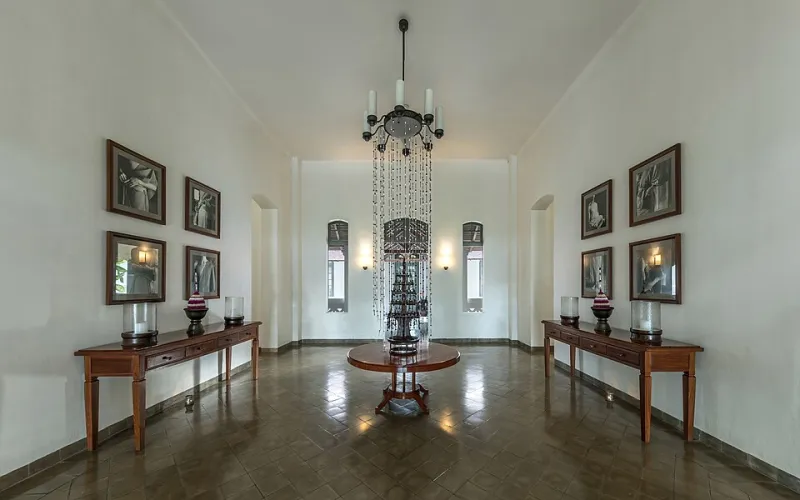
Photo: Basile Morin, CC BY-SA 4.0, via Wikimedia Commons
Step into the lobby of a truly exceptional resort and something happens before your eyes have fully adjusted to the light. Before you register the soaring ceilings, the floral arrangements, or the immaculate reception desk, a scent reaches you—subtle, deliberate, and entirely unmistakable. It is not accidental. It was designed.
Across the United States, the most discerning luxury hospitality brands are investing in what fragrance consultants call olfactory architecture: the precise, intentional curation of scent environments that anchor a property's identity as firmly as its physical design. What was once considered a secondary consideration—a pleasant diffuser in the spa, perhaps a linen spray in the guest suites—has evolved into a sophisticated branding discipline with measurable consequences for guest loyalty and emotional recall.
The Science Behind the Strategy
The case for scent as a branding instrument is rooted in neuroscience. Of all the human senses, smell maintains the most direct pathway to the brain's limbic system, the region governing emotion and memory. Unlike visual or auditory stimuli, which are processed through layers of cognitive filtering, a scent can trigger an emotional response almost instantaneously and with remarkable specificity.
For luxury resort brands, this represents an extraordinary opportunity. A guest who encounters the same fragrance—whether in a lobby, a turndown amenity, or a branded candle gifted upon departure—is neurologically primed to associate that scent with the entire emotional landscape of their stay. The warmth of a firelit lounge, the particular quality of afternoon light over a private pool, the feeling of being genuinely cared for: all of it becomes encoded alongside a single olfactory signature.
Fragrance consultants who work within the hospitality sector describe the briefing process as remarkably similar to architectural design. "We begin by asking what emotion the property wants to be remembered for," notes one New York-based independent fragrance developer who has worked with resort clients across the Mountain West and Gulf Coast. "Is it expansiveness? Intimacy? A sense of deep calm? The scent has to answer the same question that every piece of furniture and every sightline is already answering."
Crafting the Signature
The development of a resort's olfactory identity is neither quick nor inexpensive. Premium fragrance consultancies typically spend months in conversation with a property's creative and brand leadership before a single accord is finalized. Extensive site visits are conducted to understand the natural aromatic landscape—the salt air of a coastal property, the cedar and sage of a high-desert retreat, the green, mineral quality of a property set among old-growth forests.
These environmental references are rarely replicated literally. More often, they serve as inspiration points that a master perfumer translates into something refined and controlled: a fragrance that suggests the natural world surrounding a property without smelling like a walk outdoors. The distinction matters. Luxury, after all, is not nature in its raw state—it is nature curated, elevated, and made safe for contemplation.
Once a signature accord is established, it is typically deployed across multiple touchpoints within the property. The lobby diffusion system is the most prominent, but a fully realized olfactory program extends into guest rooms, spa corridors, fitness facilities, and even the subtle scenting of stationery and branded packaging. Each application is calibrated for intensity. A guest suite, where a visitor will spend eight hours sleeping, demands something far more restrained than a grand entrance hall where the fragrance must perform across an open, high-ceilinged space.
The Memory Architecture of Departure Gifts
Among the most strategically intelligent applications of olfactory branding is the departure amenity. Many of America's top-tier resort properties now include a small, beautifully packaged iteration of their signature fragrance—a room spray, a hand lotion, a single-wick candle—as part of the farewell experience. The gesture is gracious in the immediate sense, but its longer-term function is something more calculated.
When a guest returns home and lights that candle, or applies that lotion, the entire emotional experience of their stay is briefly but powerfully reconstructed. The resort, in effect, continues to inhabit the guest's life long after checkout. Brand consultants who specialize in luxury hospitality describe this as extended residency—the property's identity persisting in the guest's sensory world well beyond its physical boundaries.
The commercial logic is compelling. In an environment where luxury resort guests have access to an abundance of world-class options, the decision to return to a particular property is rarely made on a rational basis alone. Emotional attachment—the feeling of being known, of belonging to a specific place—is the more powerful driver. Scent, with its unparalleled ability to encode and retrieve emotional memory, is one of the most efficient tools available for cultivating that attachment.
Restraint as a Design Principle
Perhaps the most telling indicator of how seriously the finest properties regard olfactory design is the care with which they avoid excess. The temptation to deploy a signature fragrance at high intensity—to ensure guests notice it—is one that sophisticated hospitality brands consistently resist. An overpowering scent is not a luxury experience; it is an imposition.
The best examples of olfactory branding in American resort hospitality are those that guests struggle to consciously identify but would immediately notice if removed. The fragrance functions in the background of awareness, shaping mood and emotional tone without demanding attention. It is, in this sense, the perfect analogue to the broader philosophy of understated luxury: present everywhere, announced nowhere.
This discipline extends to the question of where a signature scent is not deployed. Dining environments, for instance, are almost universally kept fragrance-free among properties that take their culinary programming seriously. The aromatic experience of a meal is its own carefully constructed sensory event, and introducing a competing fragrance would constitute a failure of hospitality rather than an enhancement of it.
An Investment in Belonging
For guests of America's most distinguished resort destinations, the olfactory experience is rarely something they arrive thinking about. It is, in the truest sense, a background pleasure—one that contributes to a general feeling of rightness, of having arrived somewhere that has been considered from every angle.
That feeling of comprehensive consideration is ultimately what separates a truly exceptional property from one that is merely expensive. And if a single, perfectly calibrated fragrance can quietly anchor an entire emotional experience—can make a guest feel, months later, a sudden and inexplicable longing for a particular place—then the investment in olfactory design is not a luxury at all.
It is, rather, one of the most efficient forms of hospitality a resort can offer.