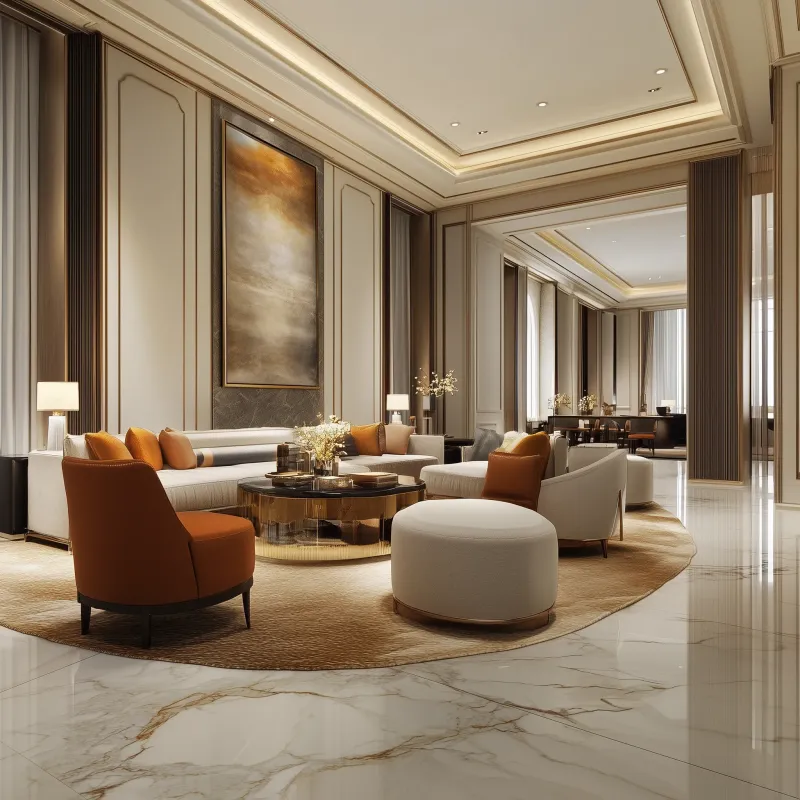
The Art of Less: How the Most Sophisticated Resorts Are Using Restraint to Define True Luxury
There is a particular kind of room that announces itself immediately. You have been in it. The scent hits you at the door—floral, insistent, designed to impress. The music fills every corner without quite fitting any of them. Surfaces gleam with an enthusiasm that borders on anxiety. Everything is present, and somehow nothing is felt.
Now consider a different room. You cannot immediately identify what makes it exceptional. The air carries something faintly botanical—cedar, perhaps, or white tea—that you notice only when you stop moving. The lighting is warm without being theatrical. Beneath your feet, a natural fiber rug absorbs sound in a way that makes the space feel somehow larger than its dimensions suggest. A single object on the desk—a smooth river stone, a hand-bound notebook—invites your hand without demanding your attention.
This is the room that stays with you.
The world's most thoughtful hospitality brands have understood for some time that the second room is far more difficult to create than the first. And it is precisely that difficulty—the discipline required to edit rather than accumulate—that has made sensory minimalism the defining aesthetic of contemporary luxury.
Precision Over Profusion
The instinct to equate luxury with abundance is deeply human. More has long served as shorthand for better, and the hospitality industry built much of its vocabulary around this assumption. Richer fabrics, more elaborate menus, louder statements of quality—these were the currencies of distinction.
What the most sophisticated resorts have recognized, however, is that abundance without intention creates noise. And noise, regardless of its source, is the enemy of genuine relaxation.
The shift toward what might be called sensory minimalism is not a movement toward austerity. It is, rather, a movement toward precision. The question is no longer how much can be offered, but which elements, deployed in what combination, at what moment, will create an experience that resonates at a genuinely felt level.
This demands a different kind of expertise—one that draws as readily from neuroscience and psychology as from traditional hospitality craft.
Sound as Architecture
Consider the role of music in a luxury resort environment. The conventional approach treats ambient sound as background—something to fill silence and create atmosphere in a general sense. Playlists are assembled for mood categories: energetic for the pool deck, serene for the spa corridor.
The more considered approach treats sound as a structural element of the guest experience, as carefully calibrated as the furniture arrangement. Properties working at this level commission bespoke soundscapes rather than licensing playlists. They attend to the acoustic properties of individual spaces, adjusting not merely volume but frequency and rhythm to complement the natural resonance of each room.
Critically, they also attend to silence. The deliberate absence of sound—particularly in wellness environments—has emerged as one of the most valued sensory offerings available to American travelers accustomed to the relentless acoustic texture of daily life. When silence is provided with intention rather than oversight, it communicates something that no playlist can replicate: that this space was designed for you to actually rest.
Scent, Memory, and the Considered Environment
Of all the senses, olfaction is perhaps the most direct route to felt experience. Scent bypasses the rational mind almost entirely, connecting immediately to the limbic system and, by extension, to memory and emotion. This is why the smell of a particular hotel corridor can return to you years later with startling vividness.
The most sophisticated properties have moved well beyond the branded fragrance diffused uniformly throughout public spaces. In its place, a more nuanced approach: different olfactory signatures for different areas, times of day, and even seasons. A morning scent in the dining room—bright, citrus-forward, subtly energizing—gives way to something warmer and more resinous as the evening progresses. Guest rooms may carry a trace of locally sourced botanicals specific to the region, creating an olfactory connection to place that generic luxury products cannot achieve.
The key, invariably, is restraint. The goal is not for guests to notice the scent, but for its absence to be felt if it were removed.
Tactile Intelligence: What the Hands Know
Texture is perhaps the most undervalued dimension of sensory design in hospitality environments, and yet it is among the most immediately felt. The weight of a linen sheet, the grain of a wooden surface, the give of a mattress edge when you sit—these details register before conscious evaluation begins.
Resorts committed to sensory minimalism approach tactile design with the same precision applied to other sensory dimensions. Natural materials are preferred not merely for their aesthetic qualities but for their sensory authenticity: the slight irregularity of handwoven textiles, the cool density of natural stone, the particular warmth of solid wood. These materials communicate quality in a way that synthetic approximations, however technically accomplished, do not.
Equally important is the avoidance of tactile contradiction—the experience of encountering a beautifully appointed room in which one jarring element (a plasticky remote control, a synthetic bath mat) disrupts the coherence of the whole. Sensory minimalism attends to these details with particular care, understanding that the integrity of an experience is only as strong as its weakest sensory moment.
Restraint as the Ultimate Statement
For American travelers whose exposure to luxury has historically been shaped by maximalist conventions, the shift toward sensory minimalism may require a recalibration of expectations. The properties practicing this philosophy do not announce their sophistication. They embody it.
This is, ultimately, the deepest expression of the philosophy: that genuine luxury does not need to convince you of anything. It simply provides an environment so precisely attuned to human comfort and sensory wellbeing that the experience of being within it feels, almost inexplicably, like coming home.
The art of less, practiced at this level, is not a subtraction. It is a distillation—and distillation, as any connoisseur understands, is where the most essential character is revealed.