Stillness as Status: How America's Most Discerning Travelers Are Redefining the Luxury Escape
For decades, the gold standard of a luxury vacation was measured in superlatives. The most remote overwater villa. The most exclusive chef's table reservation. The most elaborate private yacht excursion. To travel well, it seemed, was to travel relentlessly—filling every sunrise-to-sunset hour with experiences that could be catalogued, shared, and admired.
That calculus is changing.
Across the United States, a meaningful and quietly influential counter-movement is emerging among the country's most affluent travelers. These are individuals for whom time is the rarest commodity, whose professional lives are governed by perpetual motion and constant demand. When they finally arrive at a world-class resort, the greatest indulgence they can imagine is not another itinerary—it is the deliberate, unhurried absence of one.
The Exhaustion Behind the Instagram Grid
The rise of aspirational travel content over the past decade created a peculiar pressure: the obligation to perform a vacation rather than simply experience it. Bucket lists became status documents. Excursions were booked not because they offered genuine discovery, but because they produced photographs that confirmed a certain kind of worldliness.
For many high-net-worth American travelers, this dynamic has quietly soured. According to hospitality consultants tracking ultra-premium guest behavior, a growing segment of resort clientele—particularly those in the forty-five and older demographic with household incomes exceeding $500,000—are actively requesting what the industry has begun calling "low-stimulus programming." They want fewer scheduled activities, not more. They want rooms designed for contemplation. They want meals that unfold slowly, without the interruption of a glowing screen.
The irony, of course, is that choosing to do less has become its own form of sophistication.
What Intentional Luxury Actually Looks Like
Leading resort properties are responding to this shift with considerable thoughtfulness, redesigning their offerings around what might be described as curated moments of presence. The changes are architectural as much as programmatic.
Oceanfront meditation pavilions—open-air structures positioned to capture the specific quality of morning light, furnished with nothing more than a meditation cushion and the sound of water—are replacing the poolside activity stations of an earlier era. Bespoke spa rituals that unfold across two or three unhurried hours, drawing on regional botanical traditions and conducted in near-total silence, have become among the most requested amenities at top-tier properties.
Perhaps most tellingly, the chef's table dinner—long a fixture of luxury resort dining—is being reimagined with a single, non-negotiable condition: no mobile devices. Guests surrender their phones at the door and receive, in exchange, something increasingly rare in contemporary American life: two hours of uninterrupted conversation, extraordinary food, and the quiet pleasure of being genuinely present.
The Architecture of Slowness
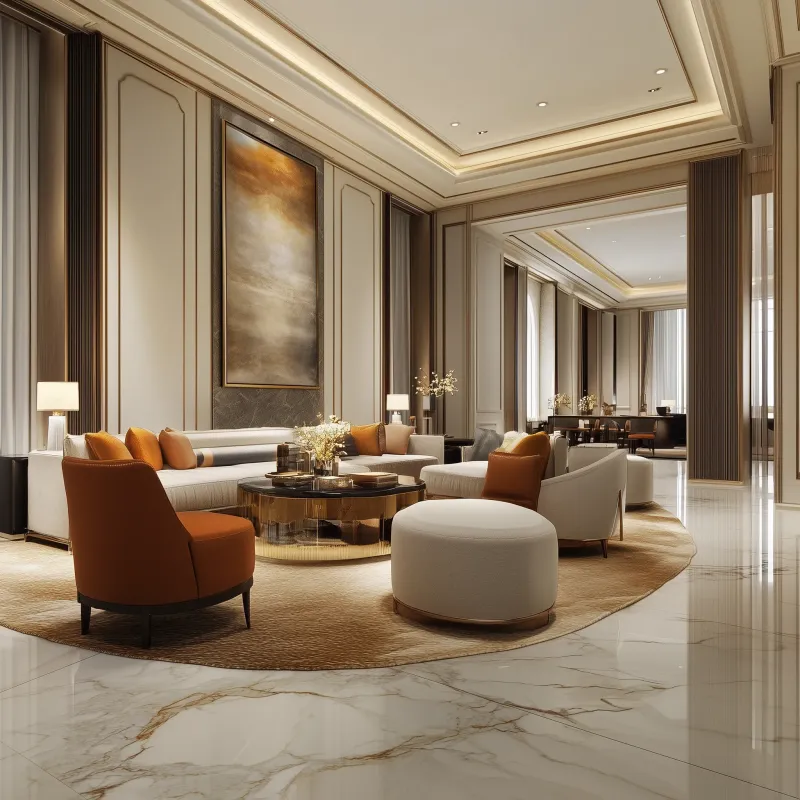
Design itself has become a vehicle for this philosophy. Rooms at the most forward-thinking luxury properties are being stripped of the visual noise that characterized resort interiors of the previous generation. Gone are the elaborate decorative flourishes and the curated collections of locally themed tchotchkes. In their place: expansive windows that prioritize natural light, furnishings in natural materials that invite touch and rest, and the considered elimination of anything that might compete for a guest's attention.
The minibar has, at several properties, been replaced by a simple wooden tray bearing a handwritten note, a glass carafe of still water, and two pieces of locally sourced fruit. The gesture is small, but its message is precise: you are not here to consume. You are here to rest.
Libraries—actual, physical libraries stocked with carefully chosen titles rather than decorative spines—have made a quiet comeback in resort common areas. Hammocks positioned in private garden alcoves. Writing desks placed beside windows with long views. These are amenities that ask something of a guest: their attention, their patience, their willingness to slow down.
Prestige Redefined
What this movement ultimately reveals is a fundamental recalibration of what prestige means in contemporary American travel culture. For a generation that came of age in the age of abundance—where the luxury market competed primarily on the basis of more, bigger, and rarer—the deliberate embrace of less represents a genuine philosophical evolution.
The most discerning travelers are no longer asking what a resort can show them. They are asking what a resort can offer them that they cannot find anywhere else in their lives. And increasingly, the answer to that question is not an excursion or an experience in the conventional sense. It is the rarest gift of all: time that belongs entirely to them, unmarked by obligation or performance.
At properties like those within the Sofitel collection, this philosophy finds natural expression. The French tradition of savoir-vivre—the art of living well, slowly, with full attention to the pleasures of the present moment—aligns seamlessly with what America's most thoughtful travelers are now seeking. Elegance, in this context, is not about spectacle. It is about the quiet confidence of a space that trusts its guests to find their own rhythm.
A Lasting Shift, Not a Passing Trend
Hospitality analysts are careful to note that this is not merely a post-pandemic correction or a momentary reaction to overscheduled lives. The data suggests something more durable: a generational reassessment of what a life well-lived actually requires, and a growing willingness among affluent Americans to invest in experiences that restore rather than stimulate.
For luxury resort properties, the implication is clear. The future of premium hospitality does not belong to the property with the longest activities menu or the most elaborate programming calendar. It belongs to the property that understands, with genuine sophistication, that sometimes the most extraordinary thing you can offer a guest is the space to simply be still.
That, it turns out, is the most luxurious offering of all.